
Pakistan National Assembly Launches Country’s First AI-Powered Parliamentary System

ISLAMABAD
Pakistan’s National Assembly on Tuesday unveiled the country’s first AI-enabled parliamentary system and announced a major digital transformation of the Speaker’s Office, marking a significant step toward modernizing legislative operations through artificial intelligence and paperless governance.
The soft launch ceremony, held at Parliament House in Islamabad, was attended by Deputy Speaker Syed Ghulam Mustafa Shah, IT Minister Shaza Fatima Khawaja, parliamentarians, senior officials from the National Information Technology Board and members of civil society.
The initiative has been launched under the leadership of Prime Minister Shehbaz Sharif and aligned with National Assembly Speaker Sardar Ayaz Sadiq’s “Digital Nation Pakistan” vision aimed at accelerating technology-driven governance reforms.
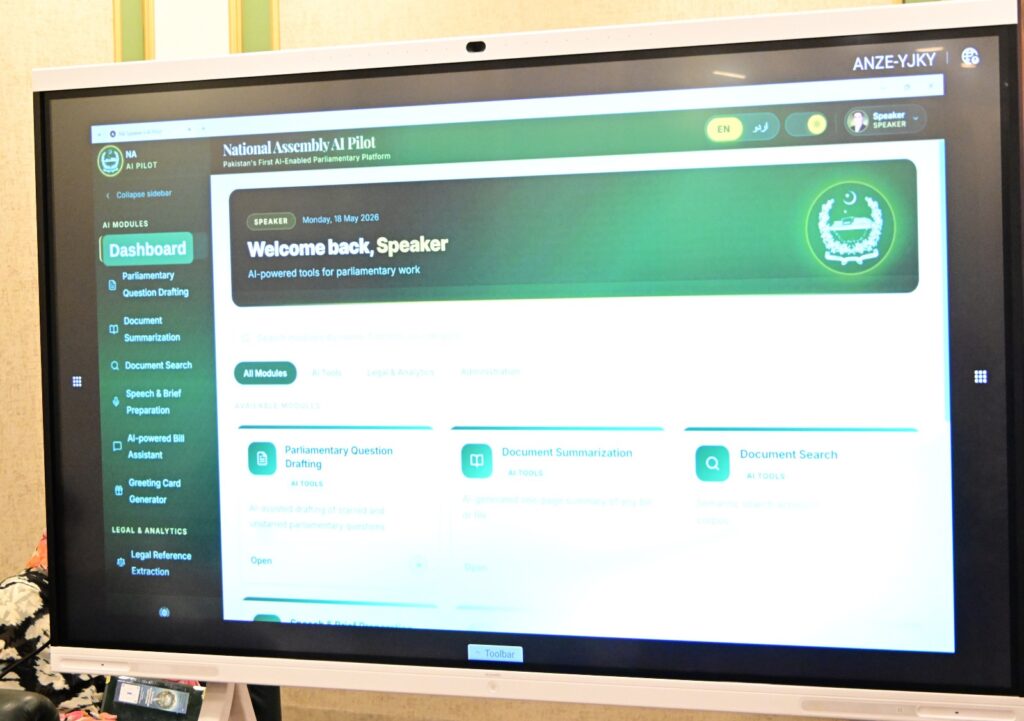
Officials described the project as a major milestone in Pakistan’s parliamentary modernization efforts, designed to improve legislative efficiency, enhance transparency and gradually transition parliamentary operations toward a fully paperless environment.
Developed in collaboration with the National Information Technology Board, the AI-powered system will assist lawmakers in managing parliamentary business through faster access to legislative records, streamlined workflows and improved coordination between parliamentary departments.
According to the National Assembly Secretariat, the platform has been developed as a fully secure, 100% on-premises AI infrastructure exclusively for parliamentary use, ensuring that all legislative and institutional data remains hosted within Pakistan under the direct control of the National Assembly.
Officials said the system was designed to strengthen data sovereignty, institutional security and operational independence while enabling more informed and timely legislative decision-making.
The initiative also aims to support lawmakers through AI-assisted digital tools intended to improve speed, accuracy and efficiency in handling parliamentary responsibilities.
Authorities said the transition toward digital workflows would additionally support government austerity measures by reducing paper consumption and improving resource efficiency, aligning with broader sustainability goals under the United Nations Sustainable Development Goals framework.
The launch reflects Pakistan’s growing push to integrate artificial intelligence into public sector governance and institutional modernization as the country expands its broader digital transformation agenda.
Analysts say the move could position Pakistan among a small group of countries experimenting with AI-assisted parliamentary systems as governments worldwide increasingly adopt automation and digital governance technologies.