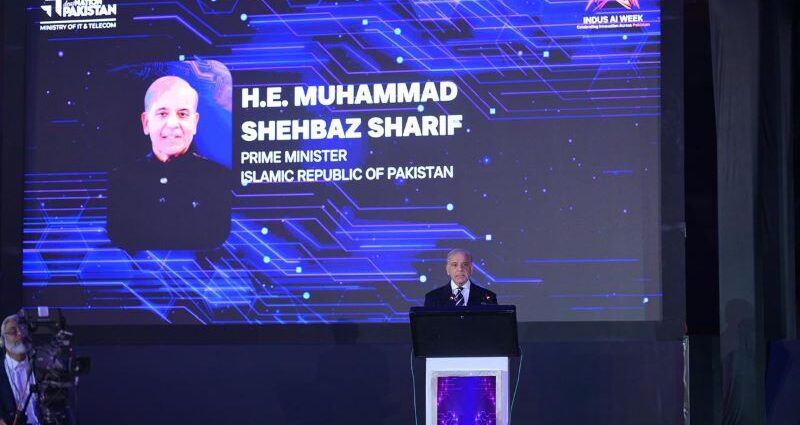
The federal government will invest $1 billion in Pakistan’s Artificial Intelligence (AI) sector by 2030, Prime Minister Shehbaz Sharif announced on Saturday, outlining an ambitious plan to build a future-ready digital economy and equip the country’s youth with advanced technology skills.
Addressing the inaugural session of Indus AI Week in Islamabad, the prime minister said the investment would be used to develop a strong and inclusive AI ecosystem across Pakistan. He added that artificial intelligence would play a central role in boosting productivity, improving governance, and creating new economic opportunities.
As part of the plan, the government will introduce AI curriculum in all federally run schools, ensuring that students are exposed to modern digital skills from an early age. In addition, 1,000 fully funded PhD scholarships in AI will be offered to students from across the country by 2030 to build a pool of high-level researchers and experts.
The prime minister also announced a nationwide training programme for one million non-IT professionals, aimed at helping workers in traditional fields adopt AI tools and improve their livelihoods. “Pakistan is absolutely ready to accept the challenge and work with our global partners with commitment and dedication,” he said.
Highlighting priority areas, Shehbaz Sharif said AI interventions would focus on agriculture, mines and minerals, industry, commerce, trade, and youth empowerment. With Pakistan’s population estimated at around 240 million, and nearly 60 per cent consisting of young people, he stressed the urgency of equipping the workforce with modern knowledge and techniques.
Responding to concerns among IT professionals about rapid technological change, the prime minister assured that government-backed programmes would help transform existing IT technicians into AI experts. He said the use of AI could lead to major gains in agricultural yield, quality and efficiency, while also supporting industrial growth and women’s empowerment.
The prime minister pointed to ongoing digital reforms as proof of Pakistan’s readiness for advanced technologies. He cited the digitisation of the Federal Board of Revenue (FBR), improved revenue recovery through data-driven systems, and the use of modern scanners and digital tools at ports to curb smuggling. “We are recovering lost revenues through technology and offering quality training to our young men and women,” he said.
Recalling earlier reforms under the leadership of Muhammad Nawaz Sharif, the prime minister said the current push toward AI builds on past digital initiatives. These included the laptop distribution programme for high-performing students in Punjab, the establishment of e-libraries in remote areas, the introduction of e-stamp papers, and the digitisation of land records with World Bank support to reduce corruption.
He also noted that Pakistan’s first Safe City project and first IT university were established in Lahore, adding that the country had learned valuable lessons from these experiences. “Today, Pakistan is ready to join the world in AI interventions,” he said.
Minister for IT Shaza Fatima Khawaja said Indus AI Week aims to strengthen coordination between universities, government institutions, and international companies. She added that the Pakistan Digital Authority is working on a nationwide digital master plan to guide future transformation.
Meanwhile, Minister for Planning Ahsan Iqbal said the world had entered a phase where intelligence itself had become a key factor of production, with nations now competing on ideas, talent, data, and technology rather than traditional commodities. He described AI as a bigger disruptor than electricity or the internet, underlining the importance of timely investment and policy focus.